Aspire Flexus SE, a replaceable coil pod read as a market signal
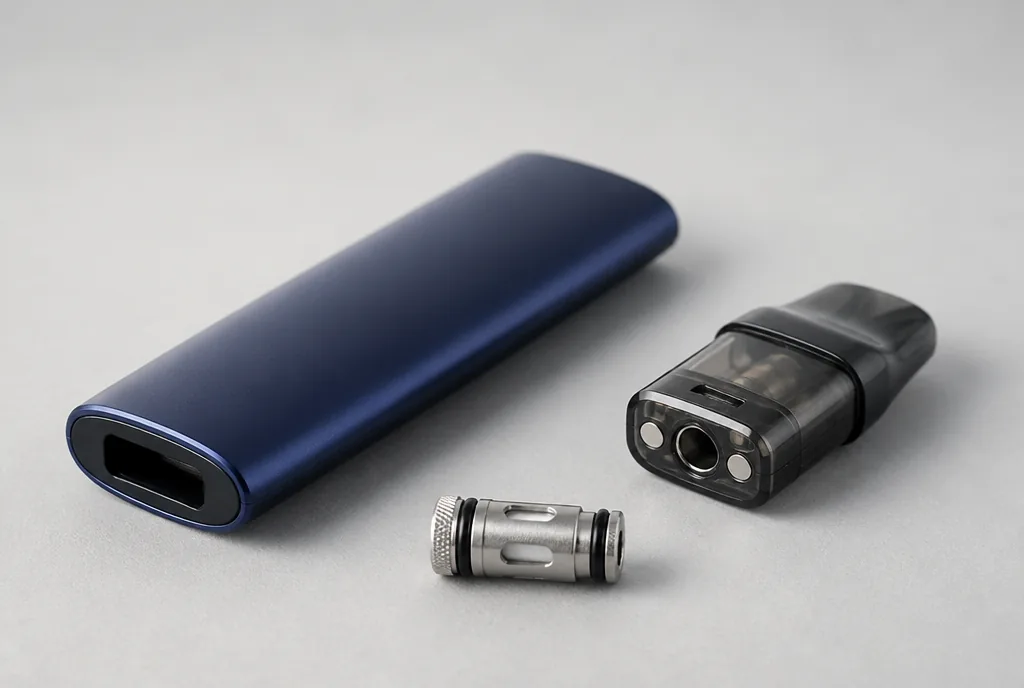
Across compact pod kits, many designs rely on a pod that carries its own coil and is replaced along with it once the flavour fades. With the Flexus SE, Aspire takes the other road, a pod you keep and a coil you change on its own. That engineering choice barely registers on a product page, yet it says a good deal about where refillable hardware is heading.
Aspire Flexus SE, what the kit actually contains
The Flexus SE is a compact pod mod style device designed by Aspire. It carries a built-in 1300 mAh cell, charges through a USB-C port rated up to 2 A and fires on inhalation, with no button anywhere on the body. Aspire gives its dimensions as 112.1 x 24.2 x 14.8 mm.
The pod fills from the side under a silicone seal and takes Aspire’s AF meshed coils in 0.4, 0.6, 0.8 or 1.0 ohm, with the 0.8 ohm coil fitted out of the box. A slider on the side of the body sets the airflow, and that is the only physical adjustment on the device.
Aspire also lists two pod capacities, 3 ml for the standard version and 2 ml for the version labelled TPD. For a British buyer that line of the spec sheet matters more than any other, and it gets its own section below.
A pod that stays, a coil that turns over
On a pod with a bonded coil, the consumable is a single block. Here it splits into two parts that wear at different speeds, which changes both what you buy again and how you look after the device.
AF coils, a platform rather than a part
The AF coil was not designed for this device. Aspire presents it as a coil with years of market presence behind it and states that every AF coil fits the Flexus SE pod, so the consumable is one already on retailers’ shelves rather than a part tied to a single body.
The value you choose sets the draw. The supplied 0.8 ohm coil is aimed at a tight mouth to lung draw, while the lower values open things up towards a restricted direct to lung inhale, used together with the airflow slider.
Looking after it, in four steps
Aspire’s manual describes a tool free coil change. You pull the pod out, pull the used coil free, push the new one into place and refit the pod, wiping away any condensation that has gathered between pod and body.
Each change therefore retires only the coil, while the pod stays in service for as long as it is in good condition. Aspire also asks for used components to go only to dedicated collection points, which ties into the wider question of vape waste in the UK.
3 ml or 2 ml, the Flexus SE TPD version
Aspire publishes two packing lists and two separate user manuals for the same device. The standard version ships with a 3 ml pod and the TPD version with a 2 ml pod, while the rest of the specification, cell, dimensions and coils included, stays the same.
In the United Kingdom, the Tobacco and Related Products Regulations 2016 cap the tanks and pods of nicotine vaping devices at 2 ml and limit nicotine containing e-liquid to 20 mg per ml in refill bottles of no more than 10 ml. The TPD version is the one built to that 2 ml figure, and the UK listing published by Vape Club gives the capacity as 2 ml.
Aspire lists both pods as compatible with the same body. Before buying, it is worth checking the capacity printed on the box and on any replacement pod, so as to stay with the 2 ml format.
For the Observatoire, this split is the clearest signal on the spec sheet. The manufacturer draws a single device and handles compliance through the pod, instead of designing a separate model for each market.
No screen, no button, and what the device decides for you
There is no screen, no button and no power setting on the spec sheet. The device fires as soon as you draw and manages its own output, which leaves the user with two levers only, the coil value and the position of the airflow slider.
Information comes through a single light that changes colour with the battery level and flashes when something goes wrong. Each flash sequence matches a specific protection.
Aspire lists those protections as a cut-off after 6 seconds of continuous drawing plus safeguards against short circuits, low and high voltage, overcharging and overheating. On hardware with no interface, they set the limits of use, the first one cutting short any long draw.
Flexus SE and Klypse, two readings of the refillable pod
Set beside the Innokin Klypse, another buttonless pod covered by the Observatoire, Aspire’s choice becomes clearer. The original Klypse runs on 2 ml pods whose mesh coil is part of the pod, so a tired coil means replacing the whole pod.
Aspire reverses the proposition. The pod on the Flexus SE becomes the durable part and the coil the only recurring consumable. Both aim at the same expectation, a device that is simple to pick up, but they spread the wear in different ways.
The Klypse relies on a minimal gesture, a pod you slot in and swap without handling any part. Its rival asks for one more step, pulling out and pushing in a coil, in exchange for a smaller consumable and four coil values to choose from.
In the market both approaches sit side by side. That coexistence suggests the refillable pod has not yet settled on a dominant format, and that the consumable remains the ground on which manufacturers set themselves apart.
Limits worth knowing before you buy
The first is the cable. Aspire’s packing list names the device, the pod, the preinstalled coil and the manual, with no USB-C cable, and retail listings say the same. Plan on a compatible cable, with Aspire recommending a 5 V charge.
The second is liquid thickness. Retailers point towards thinner 50/50 liquids rather than thick, high VG blends.
FAQ
A few questions come up as soon as the device is in hand. The answers below add to the analysis rather than repeat it.
How long should you wait after filling the pod?
Aspire’s manual asks for the pod to stand for five minutes after filling, so the cotton in the coil can soak up the liquid. A new coil goes in before the pod is filled, so the same wait applies after every coil change.
Can you buy the Flexus SE pod on its own?
Yes. Retailers sell the empty pod separately, which lets you replace a damaged pod without changing the body. Before buying, check the listing to see whether an AF coil is included and confirm the capacity shown.
What do the light colours mean?
The light shows green between 60 and 100 per cent battery, blue between 30 and 60 per cent and red below that. While charging it breathes in the colour of the level reached, then stays green for ten seconds once the cell is full.
Does this pod suit a looser, airier draw?
Up to a point. Retailers place it between mouth to lung and restricted direct to lung vaping, reached with the lowest coil values and the airflow slider open. It is not presented as a full direct to lung device.
Which other models make up the Flexus range?
Aspire’s range page also shows the Flexus Q, Stik, AIO, Peak, Pro and Blok. Their cells, pods and settings differ, and the figures quoted in this article apply to the SE model only.
What the Flexus SE signals for refillable pods
This device invents no new technology. It combines a coil already well established, a 1300 mAh cell and a body with no interface, then settles the regulatory question with a plain 2 ml pod in its TPD version. That economy of means is what makes it a good witness to the segment.
Two signals are worth following. The first is the split between pod and coil, which turns a small metal component into the real consumable. The second is the double version, which shows that one device can be matched to each market’s rules through its pod alone.
For the Observatoire, the Aspire Flexus SE will remain a useful marker for measuring how far replaceable coils gain ground against bonded pods, a question that runs through all refillable hardware and one we will keep following.
On the same subject
- Klypse, the pod kit after the disposables ban
- Disposable vape waste, the real weight of it
- Disposable vape alternatives, the UK formats
Editorial content for adult readers only. Vaping products can contain nicotine, a substance that causes addiction, and nicotine vaping products are not for sale to anyone under 18 in the UK. This article is not a buying recommendation.